Agile Project Management Handbook
Agile Project Management Handbook: A Practical Guide for Agile and Hybrid Project Managers
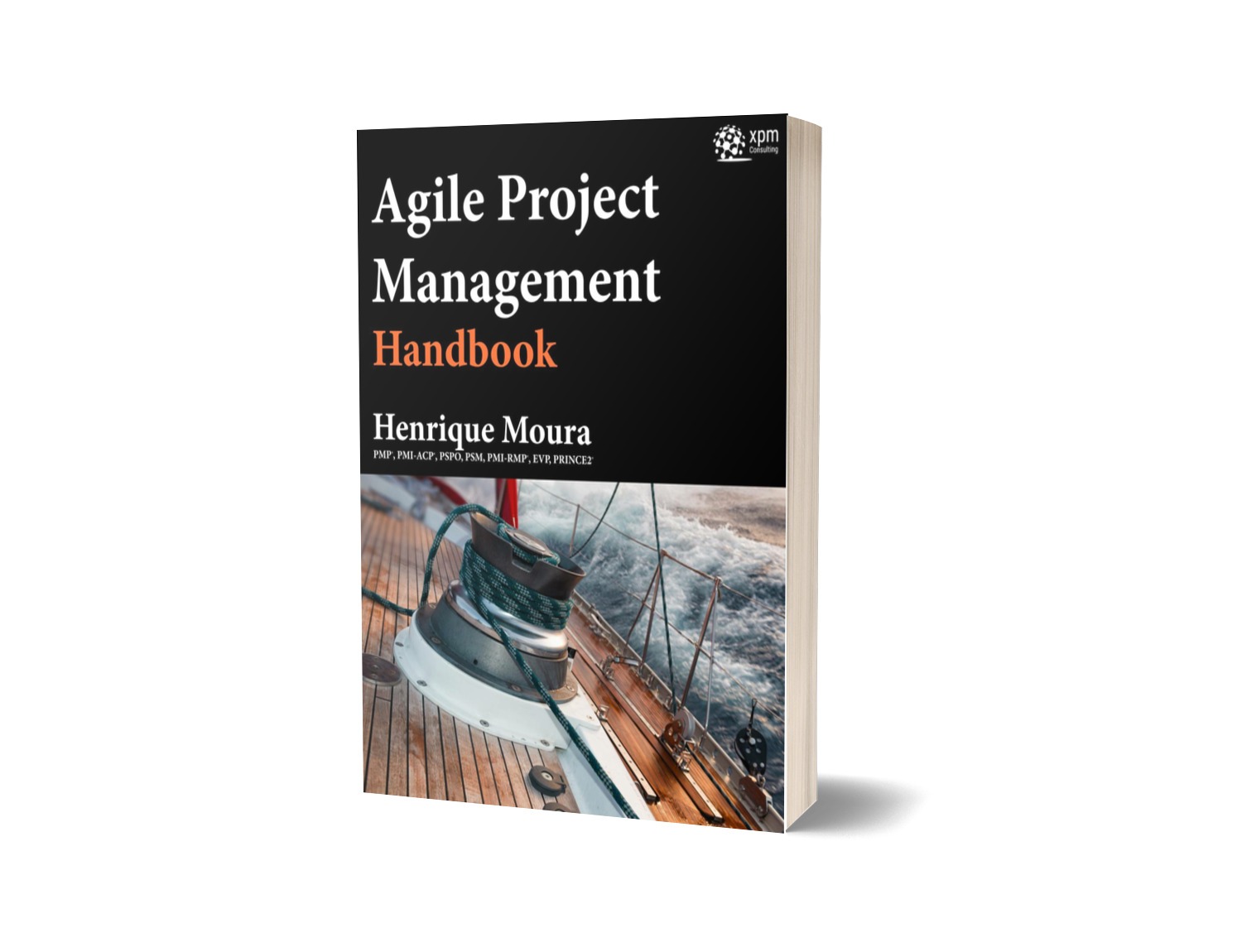
Henrique Moura’s new book, “Agile Project Management Handbook”, provides project managers with a practical, hands-on approach to Agile delivery. Moreover, it intelligently integrates Agile practices with structured governance methods. The book stands out through a case study that spans all chapters, allowing readers to understand how the concepts are applied in real-world situations.




The importance of adaptable tools
The field of project management evolves rapidly; therefore, professionals need methods that help them navigate constant changes and complex environments. This book directly addresses this need, offering practical guidance on delivering value in Agile projects, even when operating in regulated or structured contexts.
The author’s journey and motivation behind the Agile Project Management Handbook
Henrique Moura brings over 25 years of experience in project management. From his earliest projects, he realized that success depends on well-prepared teams, informed decisions, and a focus on outcomes, rather than rigid plans. The introduction of Agile practices into his career, starting in 2026, showed him that agility and structured governance are not opposing forces; on the contrary, when combined thoughtfully, they enhance team adaptability and collaboration.
What readers will find in the Agile Project Management Handbook
The book covers the entire project lifecycle: value assessment, planning, execution, monitoring, risk management, change management, quality, budgeting, and project closure. Additionally, each chapter follows a clear structure: it begins with Agile theory, provides practical guidance, and concludes with recommendations for hybrid environments, ensuring that readers can apply the knowledge regardless of project type.
The case study as a guiding thread
A project involving the development of a smart device serves as the book’s case study. In this way, readers can observe concrete decisions, shifts in priorities, and how teams respond to uncertainty. Consequently, the book bridges theory and practice, making it easier to apply Agile concepts in everyday project work.
Henrique Moura’s extensive experience
Henrique Moura has accumulated experience as a project manager, consultant, and trainer across multiple industries, including IT, telecommunications, finance, healthcare, defense, energy, manufacturing, and consumer goods. Moreover, he teaches at leading institutions such as Católica Lisbon, ISEG, Nova SBE, and FCT, as well as at international universities. He has contributed to editions of the PMBOK Guide and international standardization projects. Therefore, his experience and certifications (PMP, RMP, ACP, EVP, PSM II, PSPO, PRINCE2 Practitioner, PRINCE2 Agile Practitioner, among others) reinforce the book’s credibility.
Conclusion
The “Agile Project Management Handbook” is an essential resource for project managers seeking clarity, adaptability, and efficiency in project delivery. Additionally, it demonstrates how to integrate Agile practices in demanding environments without losing structure, while providing practical examples through the case study. Thus, it becomes a practical, up-to-date reference aligned with the daily challenges of modern project management.
In summary, this article introduces Henrique Moura’s “Agile Project Management Handbook” and explains how to apply Agile methodologies in hybrid or structured environments. Furthermore, it details the combination of agility and governance, covers the entire project lifecycle, and includes a case study illustrating real decisions and priorities. Therefore, it highlights the author’s experience in international projects across multiple industries. In this way, the guide helps project managers enhance adaptability, make informed decisions, and deliver projects efficiently in complex contexts.